Distribution: Same Old Order Fulfillment or Rapidly Changing Industry?
Change is a powerful force in the industrial world. It introduces and eliminates technologies, shifts the balance of labor from man to machine, and even reshapes consumer demand itself.
The distribution and logistics industry has experienced just such a shift in the wake of dynamic changes brought by the Covid-19 pandemic, shifting trade relationships, and rapid advances in automation and AI. These have disrupted traditional approaches to transporting goods, designing facilities, and managing labor. Many of the adaptations that emerged in response to these changes—more digital workflows, smarter operations, and regionalized and diversified supply chains—have become the new standard, fundamentally altering the ways the industry operates.
Yet even as the industry advances, familiar practices such as in-person engagement, industry networking, and traditional material planning have remained relevant, challenging industry leaders to balance rapid innovation with the enduring value of human connection.
The Industry at an Inflection Point
The pandemic exposed gaps in supply chain efficiency and reliability but also sparked innovation—particularly in distribution facility design and pre-construction. It’s fitting that such prolific disruptions as a global pandemic, AI’s sudden emergence, and persistent labor shortages would induce changes at every phase of the industry, including pre-operations. After all, pervasive challenges demand improvement at every level, and facility projects arranged for the status quo would only produce the same outcomes and pain points.
Fortunately, the distribution and logistics industry has adopted long-term shifts in design and pre-construction practices, including material price-volatility clauses, proactive supply chain management, and digital collaboration. Remote inspections, prefabrication, and integrated safety protocols are now standard operating procedures, designed for efficiency and implemented on projects large and small.
Digital by Design
The widespread adoption of digital design workflows is clear in the Design-Build Institute of America’s Best Practices for Design-Build Done Right®, which highlights early alignment, transparency, and integrated digital processes as key to successful project delivery. To develop and effectively execute project-specific plans that meet customer expectations, GCs must now depend on robust digital systems that connect design intent, field work, and quality management in real time.
- Building Information Modeling (BIM) serves as the backbone for design-build coordination and data handoff, increasingly mandated by customers as a requirement for projects. BIM enables teams to identify conflicts earlier, coordinate trades more effectively, and maintain a single source of truth throughout the project lifecycle.
- Live video, drone footage, and 360° reality captures have transitioned from pandemic-era necessity to everyday tools, improving transparency for customers, Authorities Having Jurisdiction (AHJ), and decentralized teams while reducing travel and speeding up closeouts.
- Quality Management Systems further support these technologies by allowing teams to monitor, manage, and document quality across every phase of construction—from submittals and RFIs to inspections, issue tracking, and final turnover. At Gray, Procore serves as a centralized hub for daily site activities, enabling consistent reporting, faster decision-making, and real-time visibility into project performance. This level of control helps teams proactively address issues before they escalate, reducing rework and minimizing schedule risk.
This convergence of tools does more than streamline work. Facilities delivered through digitally integrated processes reach operational readiness faster, with fewer disruptions and more predictable budgets.
Procurement Is Key to Mitigating Tariff Risks
With ever-changing tariff policies causing geopolitical tension and unpredictable price swings, general contractors (GCs) must mitigate supply chain risks by integrating procurement strategies into contracts and execution plans from the start, and owners have come to expect this. Supply chain management is often front-loaded, with teams proactively vetting alternative suppliers and sourcing materials from various regions rather than relying on a single supplier.
Moreover, GCs can reinforce their procurement strategies with material-volatility clauses. These clauses are typically linked to indices such as the Producer Price Index (PPI) for Construction Materials, ensuring that material prices reflect market data rather than relying solely on supplier quotes. An emerging approach in these clauses is to include allowance provisions for materials most likely to be affected by tariffs. This provision specifies a flexible budget and allows for adjustments based on actual procurement costs.
Safety and Hygiene are the New Standard
Infectious-disease controls have become a permanent fixture of modern site safety planning and warehouse operations. What began as emergency protocols during the pandemic—sanitation stations, wellness screenings, and access restrictions—have evolved into a structured layer of GCs’ environmental health and safety (EHS) frameworks.
Today, most distribution center operators and contractors include infectious-disease prevention in their standard operating procedures, outlining how to activate and scale measures such as enhanced cleaning, personal protective equipment, and air-quality monitoring when risk levels rise. These plans are no longer viewed as temporary add-ons but as essential components of business continuity and workforce protection. The result is an industry that can quickly pivot to safeguard employees and maintain productivity in the face of future health crises or localized outbreaks.
The Human Connection Returns
While digital transformation drives efficiency, human collaboration sustains performance. The construction industry’s shift back toward in-person practices such as facility inspections and in-office collaboration underscores a timeless truth: the most complex facilities still depend on human connection. The result is a hybrid environment where pandemic-era efficiency gains persist, but human connection, operational visibility, and traditional workflows have reasserted their importance.
While remote tools helped maintain continuity during periods of disruption, the scale and complexity of designing and building distribution facilities require a high level of vigilance and adaptability. As such, in-person inspections and facility walkthroughs have returned as the preferred approach because they allow teams to directly evaluate layout efficiency, material flow, automation interfaces, and safety considerations—factors that are difficult to fully assess remotely. Hybrid work remains useful, but face-to-face engagement continues to drive clearer alignment and faster operational decisions throughout each project phase.
The return to in-person practices is also apparent within distribution organizations themselves. While hybrid work remains common, increased office presence and face-to-face collaboration support faster problem-solving between logistics operations, engineering, procurement, and IT teams. For an industry where upstream decisions directly affect throughput, order accuracy, and fulfillment speed, these renewed human connections complement digital tools and reinforce the operational discipline needed to meet customer expectations in a post-pandemic environment.
The normalization of material and lead-time planning in the distribution industry underscores the continued value of traditional workflows supported by direct communication and established supplier relationships. While certain product categories—most notably electrical components and automation-related equipment—continue to experience constraints, the broader move away from emergency procurement has improved accuracy and operational control.
Together, these trends signal a post-pandemic balance: digital tools enhance efficiency, but human connection and traditional workflows remain critical to delivering high-performing distribution facilities.
A Renewed Focus on Vendor Relationships
As businesses have once again embraced in-person collaboration, many procurement and material coordination workflows have shifted back toward established, pre-pandemic practices. To keep projects moving amid extreme uncertainty during the height of global disruption, distribution and construction teams were forced to adopt emergency planning measures such as rapid submittal reviews, accelerated buyouts, and contingency sourcing. Every decision carried the risks of volatile pricing, delayed shipments, and supply shortages. Procurement became a real-time firefight rather than a predictable process. Now, with supply chains stabilizing and global production capacity restored, organizations have been able to return to more deliberate, forecast-driven procurement cycles. Teams are once again prioritizing strategic vendor relationships and long-term scheduling over reactive, crisis-based purchasing.
Lessons learned from the industry’s global disruption have not been forgotten; rather, they have fortified the methods teams use to plan and negotiate. While the pace and pressure of pandemic-era procurement have eased, industry leaders continue to prioritize visibility, supplier diversification, and proactive communication. While pricing and lead times for most materials have normalized, some specialized product categories—most notably electrical components—continue to face sporadic constraints and years-long lead times, underscoring the industry’s need for proactive solutions and diligent sourcing.
Future Proofing Your Facility and Your Teams
As automation, robotics, and data analytics reshape distribution, one truth stands out: technology performs best when paired with adaptable teams.
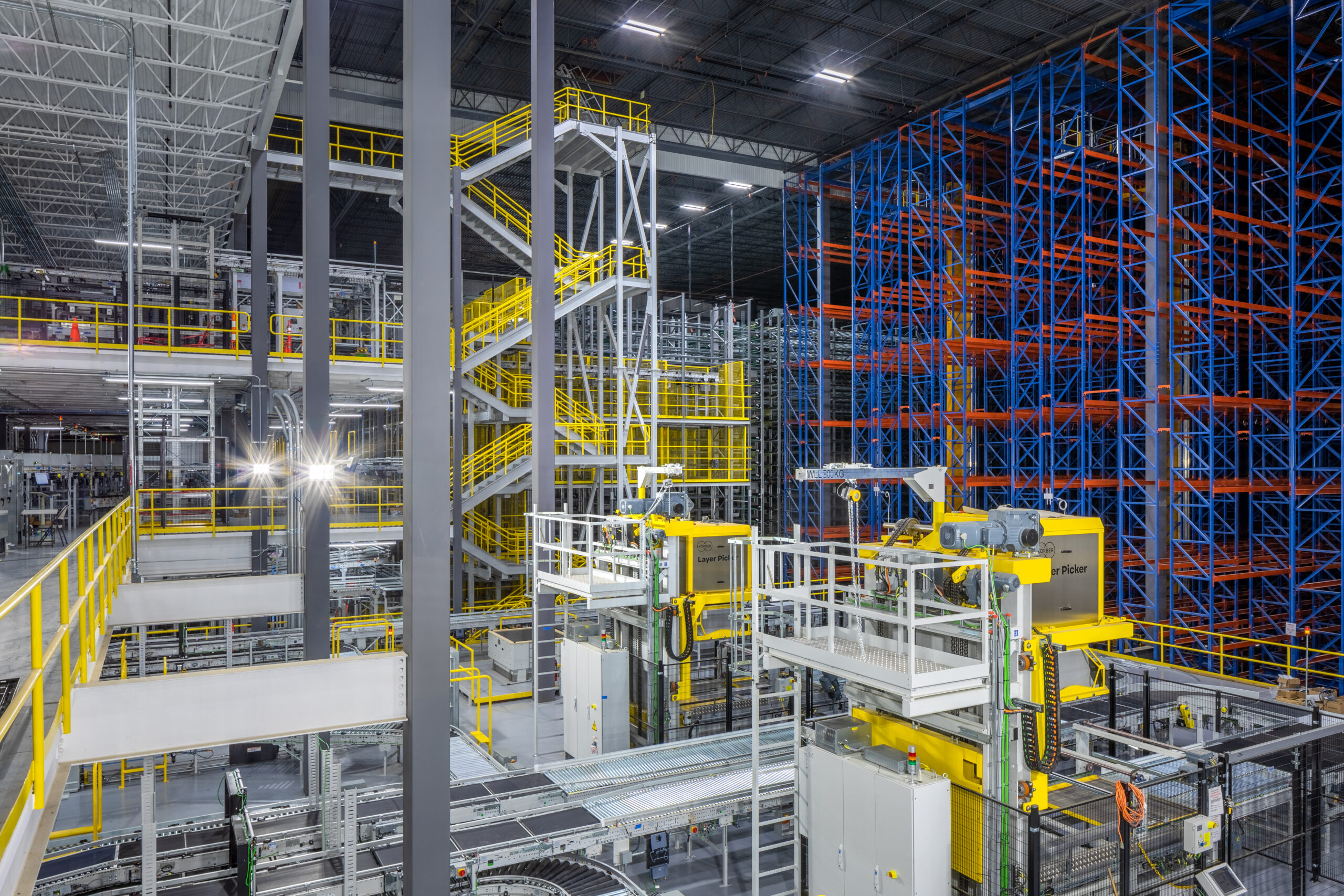
Robots and autonomous systems are streamlining repetitive tasks—picking, sorting, and palletizing—while advanced digital twin programs model entire facilities before construction. AI-driven systems like Intelligent Document Processing reduce delays and improve accuracy, turning manual workflows into intelligent, self-correcting cycles.
Distribution center automation continues to gain momentum as workforce shortages persist. Distributors are already delegating tedious and repetitive tasks to steel-collar workers, enabling teams to concentrate on more intricate tasks. It’s evident that companies reap long-term benefits by employing this approach, such as the ability to operate robots continuously without onboarding or training.
But progress brings new challenges. Investment costs for this technology can be high, and training teams to program, reconfigure, and recalibrate robotic systems requires time and resources. To keep pace with technological trends in warehouse operations, upskilling teams and investing in human-machine collaboration are essential. Seeking comprehensive technical training from your systems integration partner is crucial to ensuring positive adoption and setting up your team for success. At Gray AES, this support begins in the earliest project phases with detailed automation engineering and IT/OT systems integration, yet it continues long after facilities begin operations with ongoing technical assistance and workforce training.
Learn more about implementing automation solutions and robotics & vision systems with Gray AES.
The distribution and logistics industry stands at a defining moment. The past few years have proven that progress isn’t a choice between tradition and transformation, but a combination of the best of both. As technology continues to evolve, human insight remains its most powerful counterpart. The organizations that thrive will be those that develop the business strategies and operational tools to pair innovation with open-mindedness, efficiency with adaptability, and automation with trust.
- Category:
- Industry
- Distribution
Related News & Insights
Manufacturing, Automation Solutions
Exploring the Next Generation of Industrial Manufacturing Robots
Industry
March 03, 2026Manufacturing, Design
Process Makes Perfect: Driving ROI through Manufacturing Process Optimization
Industry
March 03, 2026Distribution, Robotics & Vision Systems
Shining a Light on the Lack of Fully Automated "Dark Factories"
Industry
January 06, 2026